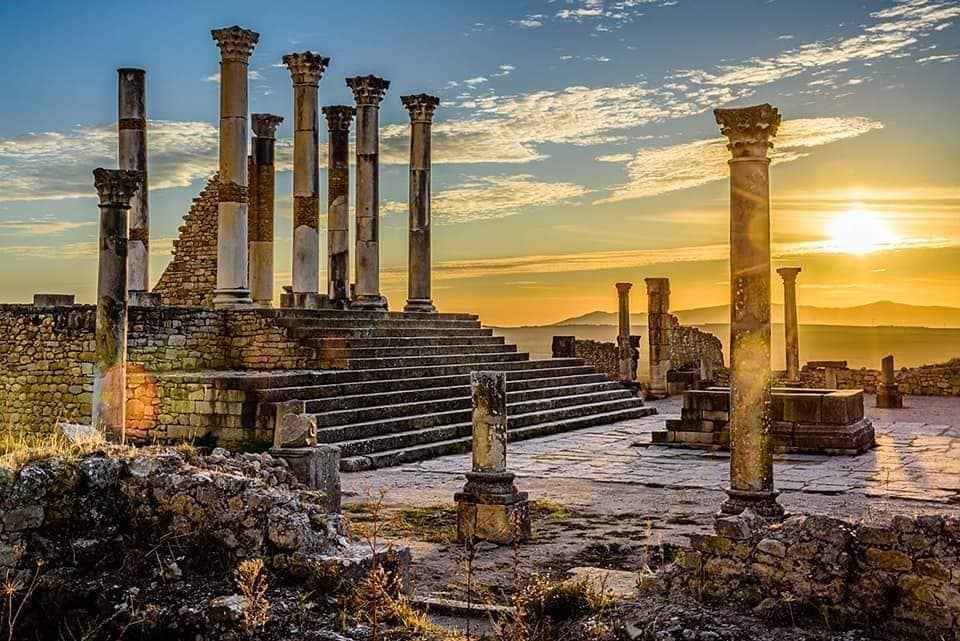
Volubilis is a partially excavated ancient Berber-Roman city located near Meknes, renowned as Morocco's most significant archaeological site. It stands as a powerful testament to the Roman Empire's presence in North Africa and is a designated UNESCO World Heritage Site.
The history of Volubilis predates the Roman era, beginning as a settlement of Berber and later Carthaginian origin. It flourished under Roman rule from the 1st century AD, becoming a major Roman colonial town and possibly the capital of the Kingdom of Mauretania. Its prosperity was largely derived from the cultivation of olives, which funded the construction of impressive public buildings and luxury town-houses featuring elaborate mosaic floors. The city was abandoned by Rome around 285 AD due to its remote location and indefensibility. However, it remained inhabited for another seven centuries, serving first as a Latinized Christian community and later as an early Islamic settlement. In the late 8th century, it was briefly the seat of Idris ibn Abdallah, the founder of the Idrisid dynasty. The ruins were largely destroyed by an earthquake in the mid-18th century before being excavated and partially restored during the French protectorate.
During its peak under Roman rule, the population of Volubilis is estimated to have been around 20,000 inhabitants, a diverse mix of Africans, Syrians, and others. Today, the site is uninhabited and serves purely as an archaeological park. The nearest major city is Meknes.
The ruins of Volubilis are exceptionally well-preserved and offer a vivid glimpse into Roman life. Key structures and features include:
Volubilis is a UNESCO World Heritage Site. It is an open-air site, so sun protection and comfortable walking shoes are essential. It is typically visited as a day trip from Meknes or Fez. The site is a powerful reminder that the Roman Empire extended far into North Africa.